
Mining Farms, Maintenance and Downtime: A Buyer's Checklist
A hosting deal is mostly a bet on uptime and on the price of a kilowatt hour. At $0.06 per kWh a 20 J/TH machine clears its power bill and little else, so every offline hour comes straight out of the margin. One hour down at 1 PH/s is about $1.68 of gross income, and a 1,000 TH/s fleet that keeps roughly $9.97 a day after power and fees gives back four days of margin for every single day it sits idle.

Key takeaways
- Run the power cliff first: 20 J/TH hardware covers $0.0841 per kWh and no more, and the listed 4% block-reward fee drops that ceiling to $0.0808.
- Price downtime in dollars. At 1 PH/s an hour offline is $1.68, so 98% availability across a 720-hour month costs 14.4 hours, or $24.19.
- Get the maintenance window, the spare-parts policy and the swap responsibility written into the schedule, not promised verbally.
- Compare quotes at one hashrate and one power price. A 1,000 TH/s deployment earns $40.39 a day gross before any deduction is applied.
Read the power clause before anything else
Breakeven is arithmetic, not opinion. A 20 J/TH machine burns 0.48 kWh for every TH/s it runs, and a TH/s produces about $0.0404 of gross income a day at a network difficulty of 132.76 T with BTC at $85,294. Divide one by the other and the ceiling is $0.0841 per kWh. The listed 4% fee on the PPS-settled block reward lowers it to $0.0808, because at 300 TH/s and below the block reward is effectively all of the income and the fee comes off it. Newer 15 J/TH hardware draws 0.36 kWh per TH/s a day, which lifts the gross ceiling to $0.1122 and the after-fee ceiling to $0.1077.
That gap decides the deal. A quote at $0.09 per kWh is comfortable for a 15 J/TH fleet and underwater for a 20 J/TH one — same rack, same contract, opposite outcome. Before you discuss anything else, ask whether the meter sits at the rack or at the building, whether cooling is included in the stated rate, and what the rate does when the operator's own power contract renews.
Then check what the fleet earns at that price. A 300 TH/s deployment produces $12.12 a day gross and $11.63 after the fee. Electricity at 7% above the breakeven line eats the whole margin, and a rate 20% above it leaves you paying to mine. That is why the kWh line deserves more attention than any uptime slogan.
What a maintenance clause really costs
Maintenance is downtime with paperwork, and downtime has a price per hour. At 1 PH/s the meter runs at $1.68 gross an hour, which converts every clause into a figure you can compare: a monthly four-hour window is $6.72, a five-day repair is $201.60, and a week of a dead PSU is $282.24. Ask for the number, not the policy.
Three questions separate a serious Miner Hosting operation from a reseller. Who absorbs the lost hours inside a scheduled window — you or the operator? Who ships the replacement part, and from where? And what is the committed turnaround, in hours, from the moment a machine stops reporting to the moment it hashes again? A provider that answers with figures has an operations team; one that answers with adjectives does not.
Spares matter more than the contract language suggests. A farm holding two spare control boards and one spare power supply per hundred machines can swap a failure the same day. A farm that orders parts per incident turns a two-hour fault into a fortnight, and at 1 PH/s a fortnight is $564.48 of income you never see.
| Clause | The number attached to it | What to ask |
|---|---|---|
| Power price | $0.0841 per kWh at 20 J/TH, $0.1122 at 15 J/TH | Is the meter at the rack, and is cooling inside the rate? |
| Uptime commitment | 98% of 720 hours means 14.4 hours down, $24.19 lost at 1 PH/s | Is the percentage monthly, and what happens when it is missed? |
| Scheduled windows | A four-hour monthly window is $6.72 at 1 PH/s | Who pays for the hours inside the window? |
| Repair turnaround | Five days offline is $201.60 at 1 PH/s | What is the committed time, and are spares on site? |
| Fee and payout method | Listed 4% on the PPS-settled block reward, 2% on the transaction-fee component; PPLNS at 2% on both | Which mode is the revenue projection built on? |
| Reporting | Per-machine hashrate, visible hourly | Can you see a dead board before the daily payout does? |
Worked example: 1,000 TH/s for 30 days
Take a 1 PH/s deployment on 20 J/TH hardware at $0.06 per kWh, and run the lines in order. Gross income is 0.00047353 BTC a day, which is $40.39 at the current price. The listed 4% fee on the block-reward component takes $1.62, leaving $38.77. Power is 480 kWh a day and costs $28.80. Margin after both lines is $9.97 a day, or $299.10 across 30 days, and the fee alone contributes $48.47 of the month's deductions.
Now stress it with downtime, because that is the line a brochure never shows. One full day offline removes $40.39 of gross income — a little over four days of margin at $9.97. A 98% uptime month removes 14.4 hours, worth $24.19, which is nearly half of one day's gross and more than two days of margin. Two unrelated faults in the same month, each lasting a day, turn a $299 month into roughly $218.
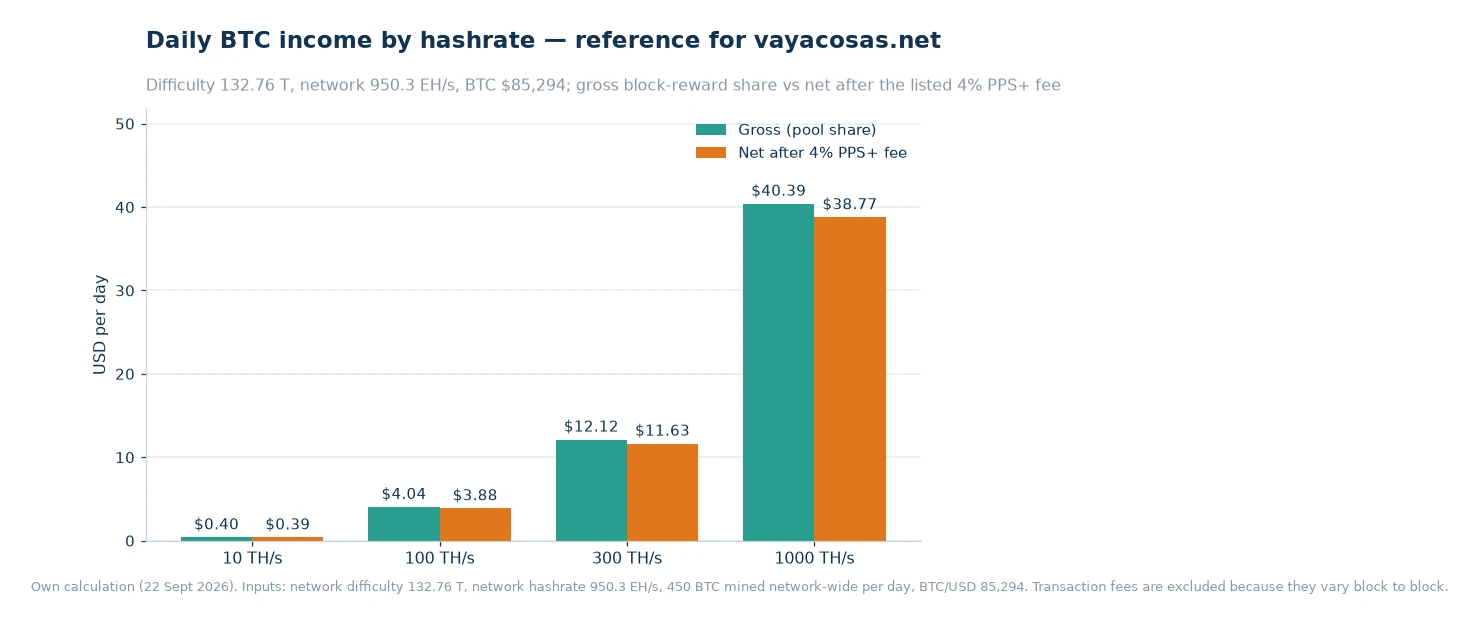
Read the chart at the low end too. A 10 TH/s machine earns $0.40 a day gross and $0.39 after the fee, so a single truck roll to swap it can cost more than a year of its output. If the fleet is small, the farm's per-incident service charge matters more than the fee schedule you spent a week comparing.
Where a directory of providers fits
Choosing between farms is a comparison exercise, and comparisons need a shortlist built the same way every time. A consolidated listing such as ViaBTC Mining Companies is useful precisely because it forces the same fields onto every candidate: what they host, where the power comes from, and what services sit alongside pure rack space. Pair that with a machine-level benchmark before you commit capital — the Miner Profitability Ranking tells you which ASIC models still clear a power bill at today's difficulty and price, and optionally the Mining Farms entry point shows what a hosted deployment looks like from the pool side.
The order matters. Screen the machines against the power price, then screen the providers against the downtime arithmetic, then read the contract. Buyers who do it the other way around tend to discover the sixth clause last, after the equipment is already on a pallet.
Frequently asked questions
What power price makes a hosting contract unworkable?
Above $0.0841 per kWh for 20 J/TH machines, because a TH/s earns about $0.0404 a day gross and burns 0.48 kWh to earn it. With 15 J/TH hardware the same line sits at $0.1122, and the listed 4% block-reward fee pulls each ceiling down by roughly four cents on the dollar.
Should a maintenance window ever be accepted at no discount?
Only if the window is small and the power price is good. Four hours a month at 1 PH/s is $6.72 of lost income, which is cheap against a half-cent per kWh advantage across a large fleet. The same window at 10 PH/s costs $67.20 a month and needs to be priced into the rate.
How do you check whether a farm is under-reporting downtime?
Compare reported per-machine hashrate against the payout. A 1,000 TH/s deployment should produce about 0.00047353 BTC a day; a shortfall of a few percent on the payout line, repeated monthly, is downtime that the uptime report does not show.
Build the checklist before you sign
Put six figures on one page: the kWh price, the breakeven ceiling for your machine class, the contracted uptime with its lost-hours value, the repair turnaround in hours, the listed fee and payout mode, and the reporting granularity. A provider that will not put all six in writing is telling you something useful. Then re-run the arithmetic when difficulty moves — the current estimate is a 1.90% increase, and every such step lowers the power price a machine can afford. The same spreadsheet that screens a farm today will screen its next contract renewal.
Data and sources: ViaBTC listed fee schedule[1]. Network difficulty (132.76 T), the implied network hashrate of 950.3 EH/s, the next-adjustment estimate of +1.90% and the BTC price of $85,294 were read 22 Sept 2026; the 0.48 kWh per TH/s per day figure is arithmetic on a 20 J/TH machine. All values are calculations from those inputs, move with difficulty and price, and are not a promise of earnings.