
The distance between an approved sample and a shipped bulk order is where most avoidable variation is introduced. When compounding, filling and testing belong to one factory, that distance is short and controllable; when they are split across suppliers, every handover is a place where a variable can change without anyone deciding to change it. This guide covers what to verify in a maker with in-house capability and which handover items actually keep a body care scent consistent from the sample you approved to the pallet you receive.
Key takeaways
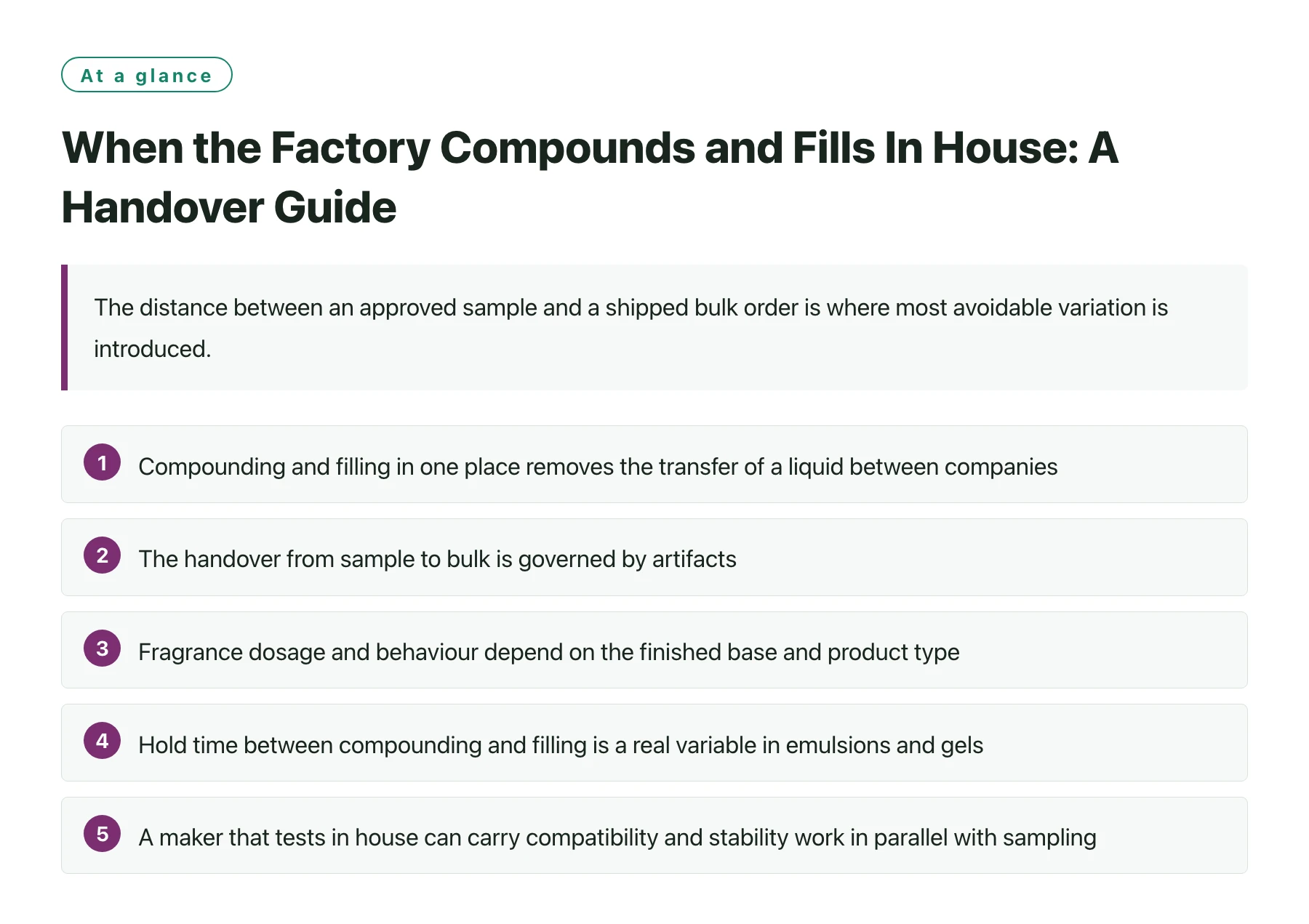
- Compounding and filling in one place removes the transfer of a liquid between companies, which is where many small differences quietly enter a project.
- The handover from sample to bulk is governed by artifacts, not intentions: a reference standard, a master formula version, a batch record and a retained sample at each stage.
- Fragrance dosage and behaviour depend on the finished base and product type, so the base belongs in the master record rather than in a covering email.
- Hold time between compounding and filling is a real variable in emulsions and gels, and it should be specified and recorded like any other process parameter.
- A maker that tests in house can carry compatibility and stability work in parallel with sampling, which shortens the schedule without shortening the testing.
Brands tend to think about manufacturing capability as a list of equipment. For a body care fragrance line, the more useful question is which steps happen inside one organisation, because ownership of a step is what makes the record for that step complete.
A maker that runs its own development lab, compounding suite, filling line and quality control can hold one document set from the first submission to the last shipping certificate. A maker that assembles the process from partners produces a complete product with a fragmented record, and fragmentation is what makes a dispute difficult to settle.
Both models can produce good goods. The difference shows up on the day something does not match, and in how many weeks it takes to find out why.
What in-house compounding and filling actually means
One owner for the liquid
In a split supply chain the fragrance compound may be made by one supplier, the base by another and the filling performed by a third. Every transfer needs a specification, a sample and an acceptance step, and each of those is a chance for a difference to be accepted as normal.
With one owner, the compound and the base meet under one set of records. Where the fragrance meets the base is also where the interesting chemistry happens: surfactants, pH and preservatives all interact with the accord, and the interaction is easier to observe and control when the same lab formulated both sides [1].
One owner for the fill
Filling determines the weight, the appearance and often the perceived quality of the finished unit. Pump primings, crimp settings, aeration and line speed all influence the outcome, and in a viscous body care product they influence it more than in an alcohol-based spray. A factory that fills on its own line can give you a fill-weight tolerance with evidence behind it rather than a figure copied from a brochure.
One owner for the testing
Testing in house compresses the loop between a question and an answer. The practical benefit is that compatibility and stability work can begin on the first viable direction while the brand is still comparing submissions, which is the single largest schedule saving in a body care project.
Dosage limits for fragrance materials are set according to product type and exposure, so the acceptable level in a leave-on lotion is not the level for a rinse-off wash [2]. A maker that owns its own testing can demonstrate how it verifies that for your specific format rather than asserting it for the category.
The handover items that keep sample and bulk together
| Handover item | What it fixes | What goes wrong without it |
|---|---|---|
| Reference standard with a batch code | The physical definition of what was approved | Odour disputes settled by memory and opinion |
| Master formula version | Which version of the accord is being produced | A bulk order made to an earlier or later version |
| Base specification | The exact base, batch and processing conditions | The same accord behaving differently in two bases |
| Dosage and addition step | When and at what temperature the fragrance is added | Top notes lost to heat or uneven dispersion |
| Hold time before filling | Aeration, viscosity and clarity at the fill point | Weight variation and visible bubbles in a gel or lotion |
| In-process checks | What is measured during the run and by whom | Problems found at release instead of during production |
| Retained samples per stage | A traceable physical record through the project | No way to locate where a difference first appeared |
| Release certificate | That the batch was compared with the standard | Goods shipped on schedule without a formal comparison |
Every row is a document or a retained object, and each one is cheap to produce at the time and expensive to reconstruct afterwards.
Running the handover
- Freeze the formula and the base togetherA formula approved in one base is not approved in another. Release both documents at the same time so the pair cannot drift.
- Scale in one step, then confirmAsk how the lab batch scales to the production batch and what the maker does if the yield is short, rather than assuming the arithmetic is linear.
- Record the addition and the holdFragrance addition point, temperature and hold time belong in the batch record, because they change the finished odour more than most brands expect.
- Compare at release, in writingBulk against pilot, pilot against reference. Three samples, two comparisons, one signed sheet.
- Keep one set of samples at each deskBoth parties retain labelled samples for the agreed period so that a question months later can be answered by comparison.
Ask to see a blank batch record before you commission anything, and ask whether compounding, filling and QC are on the same site. The two answers together tell you how much of the process you will be able to audit.
How this shows up in the schedule
In a split supply chain, the loops run mostly in sequence: the compound is made, shipped, accepted, then the base is produced, then the filling is scheduled. Each transfer needs its own sample approval, and each approval waits for a person. Moving the same project into one facility does not make any individual step faster; it lets several of them run at once.
Brands often discover the difference during the second order, when the first order's record is the thing that makes repetition easy. A maker that keeps the master formula, the base specification, the process parameters and the retained samples together can repeat a run without rediscovering decisions.
That is the practical meaning of R&D and manufacturing in one place. It is not a claim about size; it is a claim about which documents live in the same building, and it is testable during evaluation.
If the plan for the line includes more formats later, ask now how the maker handles a new base with an existing accord. The answer usually involves a fresh compatibility and stability round, and knowing that in advance keeps the second product from catching the team by surprise. The sequence that takes a scent from an approved formula to a filled unit is worth understanding before the first bulk order, because every later product repeats it; from formula to finished bottle sets that sequence out in order.
One further point is worth stating plainly: a factory that develops and produces its own scents, as Xuelei's manufacturing arm does, still expects the brand to approve the specification and the reference. In-house capability shortens the distance between the sample and the bulk; it does not replace the brand's own sign-off, and it should not.
Sources
- Chemistry World (Royal Society of Chemistry) —— The Royal Society of Chemistry's magazine, covering chemistry research and explanations of everyday materials including aroma compounds.
- IFRA Standards Library (International Fragrance Association) —— The IFRA Standards Library lists the restrictions the fragrance industry applies to individual fragrance ingredients, based on safety assessments; it is the reference point for compliant fragrance formulation.
Frequently asked questions
Is in-house compounding better than buying a ready-made base?
Not automatically. Buying a base can be faster and cheaper for a simple product. In-house compounding matters most when the fragrance has to be tuned to a specific base, when several formats share one accord, or when the brand needs the record to stay in one place.
How is a sample scaled to a production batch?
By a written scale-up method, not by multiplying the lab amounts. The maker should explain how it adjusts mixing, temperature and addition order, and confirm the result in a pilot before bulk.
Why does hold time matter in body care?
Because a lotion, gel or cream changes between compounding and filling. Aeration, viscosity and temperature at the fill point affect weight and appearance, so hold time belongs in the specification.
What should be in a batch record?
Material identities and quantities, process parameters including temperatures and hold times, in-process checks with results, yield, and the name of the person who released it.
Do I still need external testing if the factory has its own lab?
For some checks, yes. Microbiology and certain safety studies are commonly run by independent labs so that the result is verifiable by both sides and by a buyer.