
The Hidden Cost of a Fragmented Setup: Hours, Not Percentages
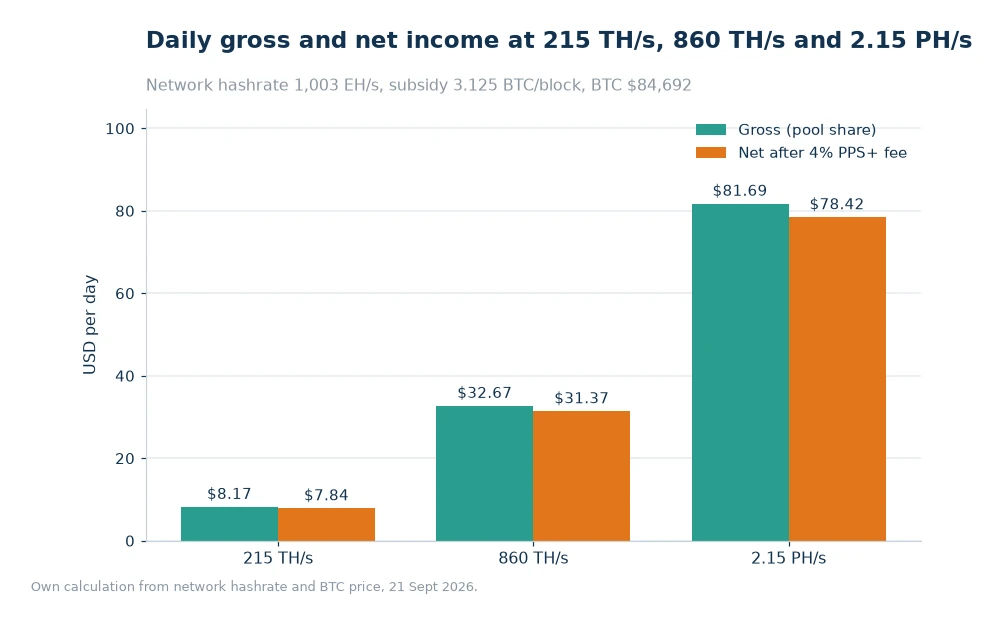
Miners compare fee schedules to two decimal places and then spend four hours a week reconciling three dashboards, two wallets and a coin they forgot they were mining. At 215 TH/s the operation produces 9.645e-05 BTC a day, $8.17 at $84,692 per BTC and $7.84 after the listed 4% on the block-reward component, which is about thirty-three cents an hour. Admin time has a price, and it is measured in the same units.

Key takeaways
- 215 TH/s nets $7.84 a day, roughly $0.33 an hour, which is the rate to compare against admin time.
- 860 TH/s nets $31.37 a day and 2.15 PH/s nets $78.42 a day, or about $3.27 an hour.
- Hourly settlement produces 24 records a day, so a manual reconciliation habit scales badly with fleet size.
- Zero-fee mining payouts remove transfer charges, but they do not remove the time spent checking them.
Three setups with the same hashrate
Setup one is a single account on a multi-coin pool, with the mined balance, the wallet and the payout history in one place. Setup two is three accounts on three pools, one per coin, each with its own address book and its own statement. Setup three is a single account plus a spreadsheet maintained by hand from a public block explorer.
All three produce the same coins from the same machines. They differ in the number of places a number can be wrong, and that number is the real cost. A daily check on setup one is one screen and two minutes. The same check on setup two is three logins, three exports and a decision about which timestamp to trust.
Counting the hours honestly
Most operators underestimate their own time because it is spread across the week in five-minute pieces. The way to count it is to log a single week: every time you open a mining-related tab, note the start and end. The total is usually between three and six hours for a small multi-coin operation, and it is almost all reconciliation rather than maintenance.
The comparison that follows is uncomfortable but useful. At 2.15 PH/s the net output is $78.42 a day, so an hour is worth about $3.27 of production. Four hours a week is $13.08 of output, or roughly $57 a month, spent on bookkeeping that a single account would reduce to one. At 215 TH/s the same four hours is worth $1.31 a week, which is less than the value of the time itself.
What automation can and cannot fix
Automation handles the mechanical parts well: scheduled conversion of mined coins, alerts when hashrate drops, hourly credits instead of a monthly lump. Auto Conversion is a good example, because it removes a repeated decision and replaces it with a rule. Alerts are another, because they turn a daily check into an exception report.
What automation cannot do is decide whether a number is plausible. That still requires a human comparing the credited coins with the formula, and the comparison is quick only when both sides are visible at once. The value of consolidation is not that it removes the check; it is that it makes the check small enough to survive a busy week.
Output at three scales
The table converts hashrate into daily and hourly income, which is the denominator for any time-cost argument.
| Hashrate | BTC per day | Gross per day | Net per day | Net per hour |
|---|---|---|---|---|
| 215 TH/s | 0.00009645 | $8.17 | $7.84 | $0.33 |
| 860 TH/s | 0.00038584 | $32.67 | $31.37 | $1.31 |
| 2.15 PH/s | 0.00096450 | $81.69 | $78.42 | $3.27 |
The hourly column is not a claim that mining runs on an hourly wage. It is a unit converter: it lets an hour of admin be compared with an hour of production on the same scale. Once that comparison exists, consolidation stops being a matter of taste.
Worked example
Build the daily figure, then use it to price a week of admin.
- Network share: 215 divided by 1,003,000,000 TH/s equals 2.144e-07.
- Daily coins: 2.144e-07 multiplied by 450 BTC equals 9.645e-05 BTC.
- Gross value: 9.645e-05 multiplied by $84,692 equals $8.17.
- Listed fee: 4% of $8.17 is $0.33, leaving $7.84 net.
- Hourly rate: $7.84 divided by 24 equals about $0.33.
- Four times the hash at 860 TH/s: 0.00038584 BTC, $32.67 gross, $31.37 net, $1.31 an hour.
- Ten times the hash at 2.15 PH/s: 0.00096450 BTC, $81.69 gross, $3.27 of listed fee, $78.42 net, $3.27 an hour.
- Cost of four admin hours a week at 2.15 PH/s: $3.27 multiplied by 4 equals $13.08, or $56.68 over a 30-day month.
- Thirty days of net output at 2.15 PH/s: $2,352.60, which is the figure the month's books should reconcile to.
A consolidation checklist
List every login used for mining and every address that receives a payout. If the list is longer than two, there is a saving available. Then map which coin is mined where, and whether the same coin is mined in more than one place; duplicate sources of the same coin are the most common cause of a reconciliation that never closes.
Next, move the payout addresses to one wallet and confirm the change with a small test payment before redirecting the fleet. Keep the old accounts open for one full settlement window, then close them. Finally, replace the manual spreadsheet with the payout history itself and keep a five-field daily row for the numbers the pool cannot know, such as meter readings.
The ViaBTC App covers real-time monitoring and alerts on iOS and Android with multi-account management, which is the piece that makes a consolidated setup workable when the operator is not at a desk. Alerts replace the habit of checking, and checking is the task that gets dropped first.
The parts that stay manual
Some work does not consolidate. Physical maintenance, tariff negotiation and hardware purchases all remain local, and no account structure changes them. What consolidation does is free the hours currently spent on reconciliation so they can go to those tasks instead, which is where the returns actually are.
There is also a risk argument. Every additional login is another set of credentials and another address book that can go stale. A smaller number of well-maintained access points is easier to keep secure than a larger number of forgotten ones, and the security benefit compounds with the time saved.
The ViaBTC Mining Pool account combines the pool, a multi-currency wallet and one payout history across more than 20 supported coins, which is the structure the checklist above is trying to reach. The fee schedule is worth reading on its own terms, but the operational saving is the part that shows up every week.
Frequently asked questions
How much is an hour of mining output worth at 2.15 PH/s?
About $3.27 after the listed 4% on the block-reward component, based on $78.42 a day divided across 24 hours.
Does a single account reduce fees as well as time?
Not by itself. The listed rates apply per component, so the saving from consolidation is operational; the fee depends on which payment method you choose.
Is it worth consolidating a two-machine setup?
Usually yes, because the reconciliation work is the same whether the fleet is two machines or twenty, and the hourly output at small scale makes wasted admin relatively more expensive.
Count the hours before the basis points
Log one week of mining admin, total the hours, and multiply by the hourly output for your hashrate. If the result is larger than the fee difference you have been researching, the next improvement is organisational rather than financial. Most small operations find that it is.
Sources: published fee and settlement terms[1], with chain inputs read 21 Sept 2026: network hashrate about 1,003 EH/s, difficulty 132.76 T, subsidy 3.125 BTC per block over 144 blocks a day and BTC at $84,692. Figures read 21 Sept 2026, published 22 Oct 2026. Time costs use the stated four-hour assumption and will differ by operator.